
IP Rotation for Reliable Authorized Data Workflows
An IP rotating proxy server is a clever bit of tech that hands you a different IP address for each connection you make. This spreads your authorized web scraping across many IPs instead of just one, which is the key to staying within per-IP rate limits and reducing failed requests.
A quick note on authorized use: this guide assumes you are collecting public data you have permission to access, in line with each site's terms and applicable law.
What Is an IP Rotating Proxy
Think about it like this: if you sent hundreds of requests a minute through the same door, a building's traffic controls would throttle you fast. That’s exactly what happens when a web scraper hammers a website with requests from a single, static IP address—it hits rate limits and gets blocked.
An IP rotating proxy acts as a gateway with a seemingly endless number of doors. Instead of using the same one over and over, your scraper gets a fresh door—a new IP address—for each visit. It works by routing your requests through a massive pool of available IPs. To the target website, the load is spread across many sources rather than concentrated on one, which keeps per-IP request rates modest.
This whole process distributes your data gathering across the pool, easing the load on any single address. By cycling through IPs, you can pull data at scale without exceeding the rate limits that protect a site's infrastructure.
The Growing Demand for IP Rotation
The need for tools like this isn't just for a small group of developers anymore; it's a market that's blowing up. The global rotating proxy solution market has seen explosive growth, projected to hit USD 1.45 billion by 2033. This boom reflects the massive digital shift, especially after events like the pandemic, when remote work and online activity jumped by over 50% in many industries. All that activity drove up the demand for tools that help handle restrictions and protect privacy. You can explore more data on the rotating proxy market to get the full picture.
Key Takeaway: The real value of an IP rotating proxy is its ability to spread your requests across countless IP addresses. This keeps any single IP well under a site's rate limits, turning a high-volume task into well-distributed, manageable traffic.
Core Types of Rotating Proxies
Not all proxies are built the same. Where the IP addresses in the proxy pool come from dictates how effective they are, what they cost, and what they're best used for. Getting a handle on these differences is the first step to building a scraper that doesn't quit. You'll mainly run into three types:
-
Datacenter Proxies: These IPs are born and raised in data centers. They're fast and cheap, but their IP ranges are well known and more readily rate-limited since they aren't tied to a regular internet service provider (ISP).
-
Residential Proxies: These are the real deal—IP addresses assigned by ISPs to actual homeowners. They're less likely to be rate-limited or blocked because they carry the reputation of ordinary consumer connections, making them a strong fit for sites with stricter traffic controls.
-
Mobile Proxies: Sourced from mobile carrier networks, these IPs are linked to 3G/4G/5G connections. They carry the most trusted reputation and are often the go-to for the most demanding data collection targets.
Understanding How IP Rotation Works
Think of an IP rotating proxy as a clever traffic director for your web scraper. When your script sends out a request to grab some data, it doesn't just go straight to the target website. Instead, it makes a quick pit stop at the proxy server, which is the real brains behind the operation.
This server has access to a huge collection of different IP addresses—what we call a proxy pool. Before your request continues on its way, the proxy server grabs a fresh IP from this pool and attaches it. Your request is then sent to the website, but now it looks like it's coming from this new, randomly chosen IP address, not your own.
This whole swap happens in a split second, and it repeats for every single request you send. In effect, your scraper sends each request from a different IP. It's this distribution that keeps any one address from exceeding a site's rate limits.
Here’s a simple visual of how a proxy distributes requests across a pool of IPs.
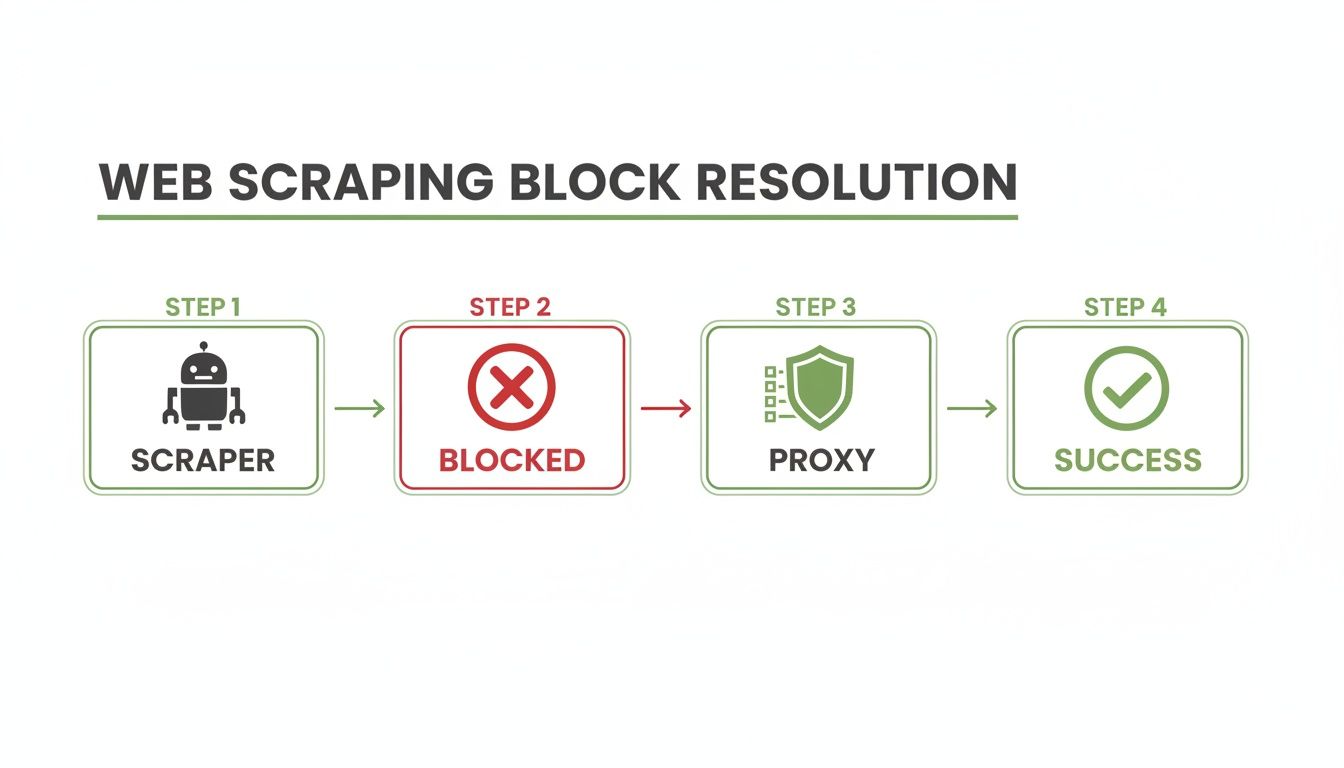
As you can see, the proxy acts as that crucial middleman, distributing the request across the pool so no single IP exceeds the target site's per-IP rate limits.
Choosing Your Rotation Strategy
Not all scraping jobs are the same, so how you rotate IPs can be tailored to what you're trying to do. There are two main approaches, each with its own strengths.
-
High Rotation (Per-Request Rotation): This is the most common and direct method. Every time your scraper sends a new request, the proxy service assigns a brand-new IP. This keeps the per-IP request rate at a minimum, making it perfect for large-scale scraping jobs where you need to pull data from thousands of pages without overloading any single address.
-
Sticky Sessions (Time-Based Rotation): Sometimes, you actually need to keep the same identity for a little while. Think about navigating a multi-step process like logging into an account, adding something to a cart, and then checking out. If your IP changed at each step, it would look incredibly suspicious. A sticky session lets you hold onto the same IP for a set amount of time—maybe one, five, or ten minutes—before it finally rotates.
Key Insight: The choice between high rotation and sticky sessions is all about your goal. High rotation is for high-volume data collection where load needs to be spread widely. Sticky sessions are for tasks that need a consistent connection across multiple pages.
The Source of the IP Matters
The power of an IP rotating proxy isn't just in the rotation itself—the quality and origin of the IPs in the pool are just as important. The two most common types come with different trade-offs in performance, cost, and how the originating network is perceived.
1. Datacenter Proxies
These IPs are created in large batches and hosted on servers in commercial data centers. They have no connection to a residential internet service provider (ISP).
-
Pros: They are incredibly fast, very reliable, and usually the most budget-friendly option.
-
Cons: Because they come from known data center ranges, they are more readily rate-limited by bot detection systems.
2. Residential Proxies
These are real IP addresses assigned by ISPs to actual homeowners. When you use a residential proxy, your traffic gets routed through a consumer connection, so it carries the reputation of an ordinary ISP address.
-
Pros: They carry the trust of ordinary consumer connections, so they are far less likely to be rate-limited. This makes them a strong fit for sites with stricter traffic controls.
-
Cons: They are generally slower and more expensive than datacenter proxies because the infrastructure is much more complex.
It’s a classic trade-off. For sites with light traffic controls where speed and cost are the main concerns, datacenter proxies are a fantastic choice. You can find out more about how to use datacenter proxies for your projects in our docs. But for the really demanding targets with strict rate limits, residential proxies are often the only way to get the job done reliably.
What Data Teams Actually Do With IP Rotation
Let's be real: the tech behind IP rotating proxies isn't the exciting part. What matters is what it lets you do. For data teams, it's the difference between a brittle script that keeps hitting rate limits and a smooth, automated engine that reliably pulls in public data. It’s the key to collecting authorized market data at scale without overloading any single IP.
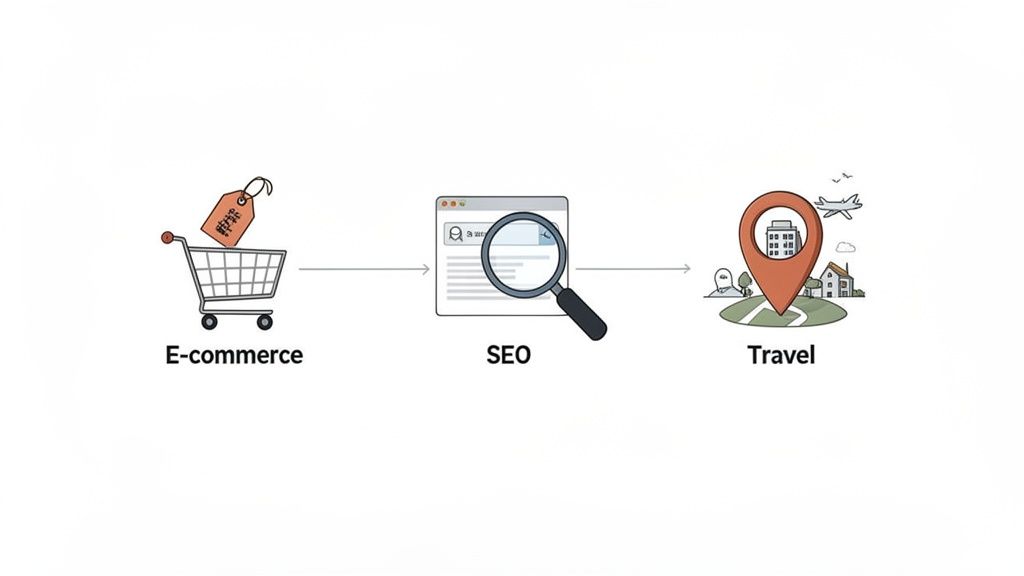
Think about an e-commerce company doing market research in a fast-moving category. Without fresh public data, they're guessing. With a rotating proxy, their data team can collect publicly listed prices, stock availability, and promotions every day without exceeding per-IP rate limits. That insight feeds directly into their own pricing strategy.
This allows them to react to market shifts in real-time and keep their pricing informed. The scraper becomes a reliable source of public market data, not some fragile script that fails every few hours.
Unlocking Geo-Specific and Localized Data
Another huge win is grabbing location-specific data. Plenty of websites show different content, prices, or search results depending on where you're visiting from. A rotating proxy with geo-targeting lets your scraper send requests from IPs in a specific region, so you see the regional version of a public page.
Here’s where that comes in handy:
-
Travel Aggregators: These guys need dead-on, localized flight and hotel prices from hundreds of different regions. A rotating proxy lets them fire off requests from IPs in New York, London, and Tokyo all at once to get the real-time pricing for each market.
-
SEO Agencies: To track search rankings properly, you have to see the results a local user would. Agencies use proxies to check keyword performance from specific cities or countries, giving their clients pinpoint-accurate data.
-
Brand Protection: Big global brands use geo-targeted scraping to find counterfeit products or unauthorized distributors in different markets. By requesting public listings from regional IPs, they can review listings that only appear to visitors in that region.
By routing requests through local IPs in the relevant region, an IP rotating proxy gives you access to a layer of geo-specific web data that a single-region setup simply can't reach. This is non-negotiable for any business with a global footprint.
Powering Market Research and Ad Verification
Beyond pricing and SEO, data teams use these proxies for broader market research on public data. For instance, they can systematically collect publicly posted product reviews to gauge how the market received a new launch, or analyze publicly available trends across different regions to inform their marketing.
A data team can also use IP rotation to review publicly displayed ads and see what creatives and campaigns are running, with the request load spread evenly across the pool so no single IP exceeds rate limits.
Ad verification is another area where rotating proxies help. By cycling through a pool of regional IPs, companies can confirm that their own ads are being displayed correctly across markets. This ensures their campaign budget is actually being spent effectively.
The benefits are clear: you spend far less time on failed requests, you can scale up your authorized data collection, and you can access region-specific public content. For a deeper dive into your options, take a look at our comprehensive guide to the best proxy services for 2025. This tech turns web scraping from a headache into a reliable part of your workflow.
Putting Rotating Proxies Into Practice (With Code)
Theory is one thing, but seeing an IP rotating proxy work its magic in a few lines of code is where it really clicks. The best part about modern proxy APIs is that they hide all the messy rotation logic. You don't have to juggle IP lists or write custom scripts to switch addresses.
Instead, you make a simple API call, and the service handles all the heavy lifting behind the scenes. This completely changes the game, turning web scraping into a straightforward data-gathering task with far fewer failed requests. This is a core part of mastering automation because it allows for scalable and surprisingly efficient scraping.
A Simple cURL Request
Let's kick things off with a dead-simple example using cURL, the go-to command-line tool for web requests. This one command perfectly illustrates how a service like Scrappey handles IP rotation for you automatically.
You just point your target URL at the API endpoint. In return, you get the page's HTML, fetched through a brand-new proxy IP.
curl -X POST "https://publisher.scrappey.com/api/v1?key=YOUR_API_KEY" -H "Content-Type: application/json" -d '{"cmd": "request.get", "url": "https://example.com"}'
See? No proxy lists, no rotation code. The API takes care of everything. Run that command again, and your request will be routed through a different IP from a massive global pool, keeping the request rate on any one IP low. That’s the core idea of an IP rotating proxy in action.
Geo-Targeting with Python
Okay, let's get a bit more practical with Python. One of the most powerful tricks up a rotating proxy's sleeve is geo-targeting—the ability to make requests from specific countries. This is a must-have for scraping localized content, pricing, or search results.
Imagine you need to grab product data from an e-commerce site as if you were shopping from Germany. With one simple parameter, you can tell the API to use a German IP.
Here’s how you’d do it with Python's requests library:
import requests
api_key = 'YOUR_API_KEY' target_url = 'https://example-store.com/product/123'
payload = { 'cmd': 'request.get', 'url': target_url, 'proxyCountry': 'Germany' # full country name (case-sensitive) }
response = requests.post(f'https://publisher.scrappey.com/api/v1?key={api_key}', json=payload)
print(response.text)
By adding 'proxyCountry': 'Germany', we're telling the Scrappey API to grab a residential or datacenter proxy located in Germany for this request. The website sees a visitor from Germany and serves up the German version of the page, giving you the exact localized data you need. You could swap Germany for Japan or Brazil just as easily.
Key Insight: Geo-targeting takes the headache out of sourcing and managing country-specific proxies. You just declare where you want to appear from, and the API does the rest. It’s your ticket to accessing geographically fenced-off data.
Managing Sessions for Multi-Step Tasks
But what if your scraping job is more complex? Think logging into an account you own, navigating to your dashboard, and then collecting data from a multi-step workflow you are permitted to access. If your IP address changes between each of those steps, the session can break and log you out, leading to failed requests.
This is where sticky sessions are a lifesaver.
A sticky session guarantees that all requests for a specific task are funneled through the same IP address, keeping a multi-step workflow consistent from start to finish. With an API, you just create a session first and then pass that unique session ID with every follow-up request.
Here's the flow for managing a session with Python:
-
Create a session: Make an initial request to start a new session, perhaps on the login page of an account you own.
-
Perform actions: Use the session ID you get back for any subsequent requests in a multi-page flow.
-
Collect data: Keep using that same session to navigate and pull data from the pages and workflows you are authorized to access.
Let's look at the code:
import requests import json
api_key = 'YOUR_API_KEY' endpoint = f'https://publisher.scrappey.com/api/v1?key={api_key}' login_url = 'https://example-site.com/login'
Step 1: Create a session and get a session ID
session_params = { 'cmd': 'sessions.create' } response = requests.post(endpoint, json=session_params) session_data = response.json() session_id = session_data['session']
print(f"Created new session: {session_id}")
Step 2: Use the session to make a request
scrape_params = { 'cmd': 'request.get', 'session': session_id, 'url': 'https://example-site.com/dashboard' } dashboard_response = requests.post(endpoint, json=scrape_params)
print(dashboard_response.text)
By passing the session_id, you're telling the API to use the same proxy IP for both requests, which keeps your session alive and your connection consistent across the workflow. You can find more details on how to create and manage sessions for your own projects. This makes multi-step scraping tasks just as simple as one-off page grabs.
Advanced Reliability Strategies
Just swapping out your IP with a rotating proxy is a solid first step, but it's only part of the picture these days. Modern websites have gotten more capable. Their bot detection systems don't just look at your IP address; they check whether the rest of your request is well-formed and internally consistent.
To keep authorized workflows reliable, your scraper has to do more than rotate IPs—it needs to present a coherent, complete browser configuration on every request. This means we move beyond simple IP rotation into the strategies that keep your requests consistent and well-paced.
Send Consistent, Well-Paced Requests
The least reliable scrapers are the ones that fire off requests one after another, all with the same incomplete signature, at perfectly timed intervals with no pauses. That pattern both strains servers and trips rate limits.
Start by sending complete, up-to-date request headers, especially the User-Agent string. This little piece of text tells a website what browser and operating system you’re using. Sending thousands of requests from different IPs but with a stale or mismatched User-Agent often causes failures.
A better approach is to keep a running list of common, up-to-date User-Agents that match the rest of your configuration. That way your headers are coherent across Chrome, Firefox, and Safari profiles on both Windows and macOS.
Hammering a server at a fixed interval is another problem—it can overload the site and trigger throttling. Introduce reasonable delays between your requests—maybe one request waits 1.5 seconds, the next waits 3.2 seconds, and the one after that waits 0.8 seconds. This pacing eases the load on the target and keeps you within its rate limits.
Keep Browser Fingerprints Consistent
The more capable websites take it a step further with a technique called browser fingerprinting. They build a profile from a whole collection of details your browser exposes, not just your IP or headers.
A website can read:
-
Your specific screen resolution and color depth.
-
The list of fonts installed on your system.
-
The exact browser plugins you have enabled.
-
Subtle differences in how your hardware renders graphics.
When you put all those data points together, you get a browser fingerprint. If a request's fingerprint is incomplete or inconsistent with its headers, verification systems often reject it. A bare scraper that only sends headers has no real browser behind it, so its fingerprint doesn't add up.
This is where a full browser engine helps. Instead of sending a raw request, these solutions use a real headless browser (think Chrome, but without the visual interface) running in the background. This produces a complete, internally consistent browser fingerprint that matches the User-Agent being sent.
To the target website, a request from a headless browser managed by a service like Scrappey presents a complete, well-formed browser profile. It has the right fonts, a standard screen resolution, and all the other markers a real browser provides.
When a CAPTCHA Appears: Treat It as a Signal
Even with consistent, well-formed requests, you may eventually hit a CAPTCHA. These "are you a robot?" tests appear when a site wants to confirm a human is present. The right response is not to push through them—it's to treat a CAPTCHA as a clear signal to change your approach.
In practice, that means:
-
Slow down and back off: A CAPTCHA often means you're sending requests faster than the site expects. Increase your delays, reduce concurrency, and give the target room to breathe.
-
Route to human review: For workflows that genuinely need it, surface the request to a person who can decide how to proceed, rather than automating around the check.
-
Seek official or authorized access: If a site consistently presents CAPTCHAs, that's a strong sign you should be using an official API or an authorized data-access arrangement instead.
A comprehensive proxy and scraping API helps by handling the reliability plumbing—proxy rotation, a consistent and well-formed browser configuration, sensible pacing, and retries on transient errors—so your well-behaved requests are less likely to trigger these checks in the first place. It is not a way to bypass a CAPTCHA, and rotating to a fresh IP is not a way to retry through one. By combining an IP rotating proxy with consistent, well-paced requests, you build a scraper that is well-behaved and resilient.
Navigating the Legal and Ethical Landscape
Using an IP rotating proxy is perfectly legal. But like any powerful tool, it's how you use it that determines whether you're being responsible. The tech itself is neutral; it's the application that raises legal and ethical questions. Smart data collection isn't just a good practice—it's the foundation of any sustainable and respectable data operation.
The first rule of ethical scraping is simple: respect the website's wishes. Before you kick off any project, always check the robots.txt file. You can find this simple text file at the root of most domains (like example.com/robots.txt), and it lays out the rules of engagement for bots, telling them which pages are off-limits. Ignoring it is basically digital trespassing.
Respecting Digital Boundaries
Beyond robots.txt, the site's Terms of Service (ToS) is your next stop. Think of this as a legally binding agreement between you and the website owner. Many ToS documents flat-out forbid automated data collection. If you violate those terms, you risk getting your access permanently blocked or, in more serious situations, facing legal action.
It's also critical to think about the kind of data you're collecting. A hard-and-fast rule is to never scrape personally identifiable information (PII). This covers names, email addresses, phone numbers—anything that could be used to identify a specific person. Scraping PII isn't just an ethical misstep; it can put you in hot water with data privacy laws like GDPR or CCPA, which come with some hefty penalties.
Ethical Framework: The core principle is straightforward—your scraping activities shouldn't harm the website or its users. This means sticking to public, non-sensitive data and collecting it in a way that’s respectful of the site's infrastructure and rules.
Being a Good Digital Citizen
Finally, consider your impact on the website’s performance. An overly aggressive scraper can hammer a server with hundreds of requests per second. This can slow down or even crash the site for real human users. Not only is this terrible etiquette, but it can also be seen as a Denial-of-Service (DoS) attack.
To stay on the right side of things, make these best practices part of your workflow:
-
Scrape at a reasonable rate: Don't just blast requests. Introduce randomized delays between them to behave like a consistent, well-formed client browser.
-
Operate during off-peak hours: Schedule your scrapers to run late at night when the site's traffic is naturally lower.
-
Cache your data: Avoid scraping the same page over and over again. Store a local copy so you don't have to keep asking the server for it.
By pairing the power of an IP rotating proxy with these ethical guidelines, you can gather all the public data you need while being a positive and lawful presence online.
Frequently Asked Questions
Jumping into the world of web scraping tools can definitely bring up a few questions. Let's clear up some of the most common ones about IP rotating proxies and get you the quick answers you need.
Regular vs Rotating Proxies
So, what’s the real difference between a regular (static) proxy and a rotating one?
Think of a static proxy like a single entrance to a building. Once all your traffic funnels through that one door, the site's rate limits kick in and you’re throttled. It gives you one IP address that never changes, so every request stacks up on the same address.
An IP rotating proxy, however, spreads that traffic across many doors. It cycles through a large pool of IP addresses for each request, keeping the request rate on any one IP low. That’s the key to staying within a site's limits and reducing blocked requests.
Do I Need Thousands of IPs?
This is a big one. Do you really need a proxy pool with thousands upon thousands of IPs?
Honestly, the quality and type of those IPs matter way more than the raw number. A small, healthy pool of high-quality residential IPs will almost always outperform a giant list of low-reputation, heavily rate-limited datacenter IPs.
For most folks, a managed service that handles the pool size, IP health, and rotation for you is the way to go. It lets you focus on building your scraper, not on the headache of managing proxy infrastructure.
Will a Rotating Proxy Slow Me Down?
It's true, adding an extra hop for your request to travel through can add a tiny bit of latency. But in reality, the delay is often so small you won’t even notice it. Premium IP rotating proxy networks are built for performance, with servers all over the globe to keep things moving lightning-fast.
The tiny trade-off in speed is almost always worth the huge boost in reliability. A slightly slower request that actually succeeds is infinitely better than a fast one that returns an HTTP 429 or 403.
Are Residential Proxies Always Best?
Not necessarily. Residential proxies carry the most trusted network reputation. They use real IP addresses from internet service providers, which makes them a strong fit for sites with the strictest traffic controls.
But datacenter proxies are often much faster and way more affordable. They’re a fantastic choice for sites with lighter traffic controls, where you're more focused on speed and keeping costs down. The best tool for the job always comes down to your specific target and what you’re trying to accomplish.
Ready to start collecting the data you're authorized to access, reliably and at scale? With Scrappey, you get access to a large, auto-rotating proxy network that handles the rotation and pacing for you. Start scraping reliably today!