
Rotating proxies for web scraping: A Guide to Reliable Data Access
Rotating proxies are a simple but powerful idea in web scraping: instead of making every request from your own IP address, you distribute requests across a pool of different IPs. This spreads load so no single address exceeds a site's per-IP rate limit, which means fewer failed requests and more consistent access to the public data you're collecting.
A quick note on authorized use: this guide assumes you are collecting public data you have permission to access, in line with each site's terms and applicable law.
Why Rotating Proxies Are Essential for Web Scraping
Most sites enforce limits on how many requests a single IP address can make in a given window. If your scraper sends thousands of requests from one static IP, you'll quickly cross that threshold and start receiving errors instead of data. Rotating proxies solve this by spreading the same workload across many addresses, so each one stays comfortably within the site's rate limits.
Relying on a single IP address is one of the most common mistakes in any serious web scraping project. Modern websites use rate limiting and bot detection systems to keep automated traffic from overwhelming their infrastructure, and a single-IP scraper runs into those limits almost immediately.
The Core Challenges of Modern Web Scraping
When you're collecting data at scale, a few site behaviors will reliably trip you up. Understanding them is the first step to building a scraper that works smoothly with a site's infrastructure.
-
Per-IP Rate Limits: If a server sees too many requests from a single IP in a short time, it starts returning errors (often HTTP 429) or temporarily refuses further requests from that address.
-
Throttling: Instead of rejecting requests outright, a site might slow you down. It'll only accept a set number of requests per IP in a given window—say, 60 requests per minute. Go over that, and responses degrade.
-
CAPTCHAs: These "I'm not a robot" challenges appear when a site's bot detection system wants to confirm a human is present. A scraper that hits one is paused until the challenge is resolved.
-
Geographic Restrictions: Some public data is only served to users in certain countries. If your scraper's IP is in the wrong location, the content you need may not be returned at all.
This is where rotating proxies for web scraping really help. Instead of sending all your requests from one IP that quickly hits its limit, you distribute them across a large pool of addresses. Each request uses a fresh IP, so the per-IP request count stays low and well within the site's thresholds.
Spreading requests this way keeps you within rate limits and reduces failed requests, which is what gives you the steady, reliable web data you need. If you're just getting started with data extraction, a good modern Python web scraping tutorial can give you the foundational skills, and you'll quickly see why proxies become important for any larger job.
How IP Rotation Works
To understand why rotating proxies are so effective, let's walk through a single request. When your scraper sends a request directly to a website, every request carries the same source IP—so they all count against that one address's rate limit.
With a rotating proxy, your request takes a different path. It first goes to a proxy server, which acts as a gateway to a large pool of IP addresses. The proxy server assigns one IP from the pool and forwards your request through it.
That assigned IP carries your request to the target website. For the next request, the proxy server selects a different IP from the pool, possibly from a different region. Because each request goes out through a different address, no single IP accumulates enough requests to trip a rate limit.
The Role of Backconnect Proxies
This process is usually managed by a backconnect proxy. The advantage is that you don't have to maintain a list of thousands of IP addresses yourself. You send all your requests to one stable endpoint—the backconnect server's address—and it handles the rotation logic for you.
A backconnect proxy is like a single dispatcher for a fleet of delivery drivers. You tell the dispatcher what you need, and it assigns an available driver for each delivery, so no single driver is overloaded.
This keeps your scraper's code clean and simple, pointing at just one endpoint, while the proxy service manages the pool and assigns a fresh IP to each request.
Skipping rotation entirely is the most common reason scraping jobs stall: a single IP hits its rate limit fast.
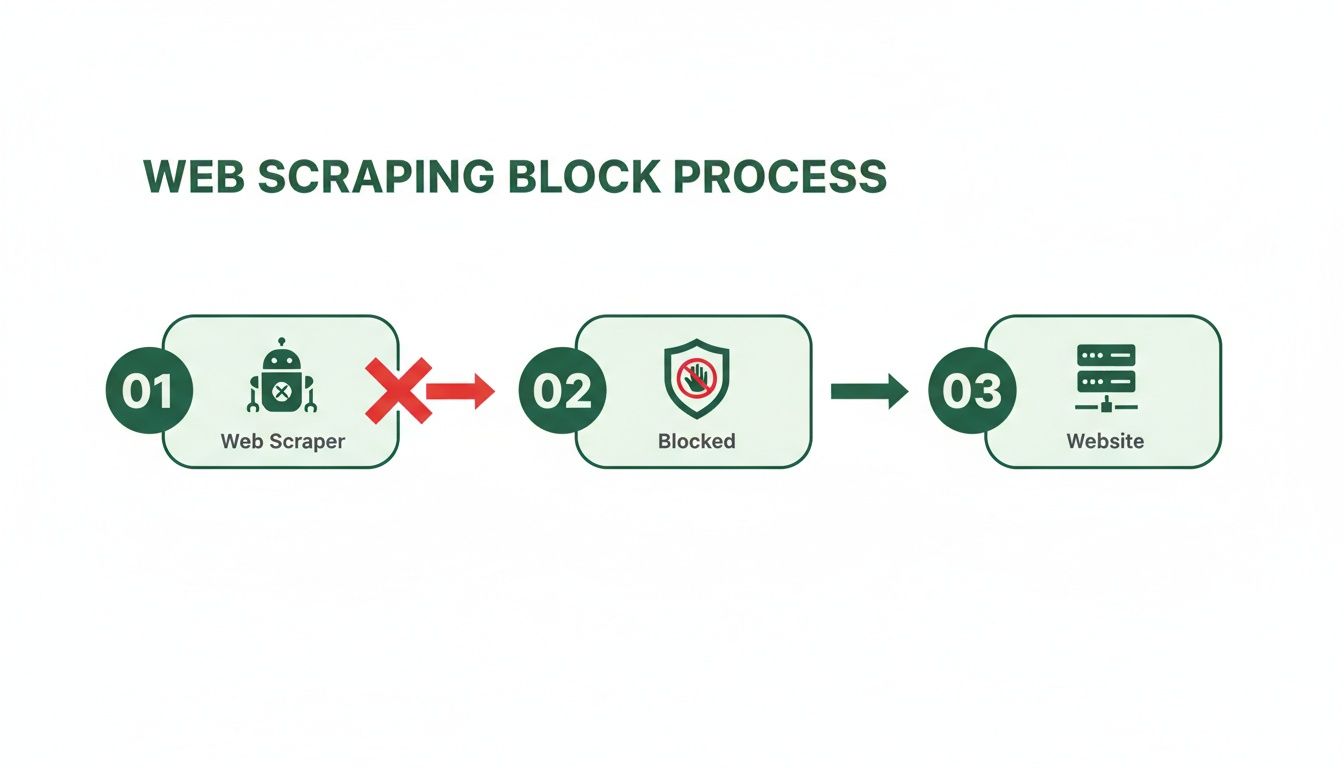
This is the classic failure point for many scraping projects. Sticking to one IP means that one address absorbs your entire request volume, and it reaches the site's per-IP limit quickly.
Automating IP Rotation with an API
You can build all this rotation logic yourself, but managing IP lists, handling failed requests, and rotating addresses correctly is a significant engineering effort. This is where a web scraping API like Scrappey comes in, reducing the process to a single API call.
Instead of building and maintaining your own proxy management system, you make a simple request. The Scrappey platform routes it through its network of rotating proxies, handling the work needed to keep your requests clean, well-formed, and consistent.
Here are the key tasks a service like Scrappey handles for you:
-
IP Pool Management: It maintains a diverse pool of residential and datacenter IPs and removes any that stop responding or start returning errors.
-
Distribution Logic: The system selects an appropriate IP type and location for the target site and rotates addresses so request volume is spread evenly and stays within per-IP limits.
-
Failure Handling: If a request fails, the API retries with a different IP. You don't have to write retry logic yourself.
-
Header Consistency: Beyond IPs, the service sends consistent, well-formed browser headers so each request is properly structured.
By bundling this complexity into one service, you can focus on the data you need to collect rather than the underlying infrastructure. That speeds up development and makes your data extraction projects more reliable.
Choosing the Right Proxy for Your Project
Proxy types differ in cost, speed, and how well they suit a given target. Picking the right one depends on what you're collecting and the site you're collecting it from.
To choose well, it helps to know where each proxy type's IPs come from. The source of an IP affects its cost, its speed, and how a site's bot detection systems treat it. Let's break down the three main types of rotating proxies.
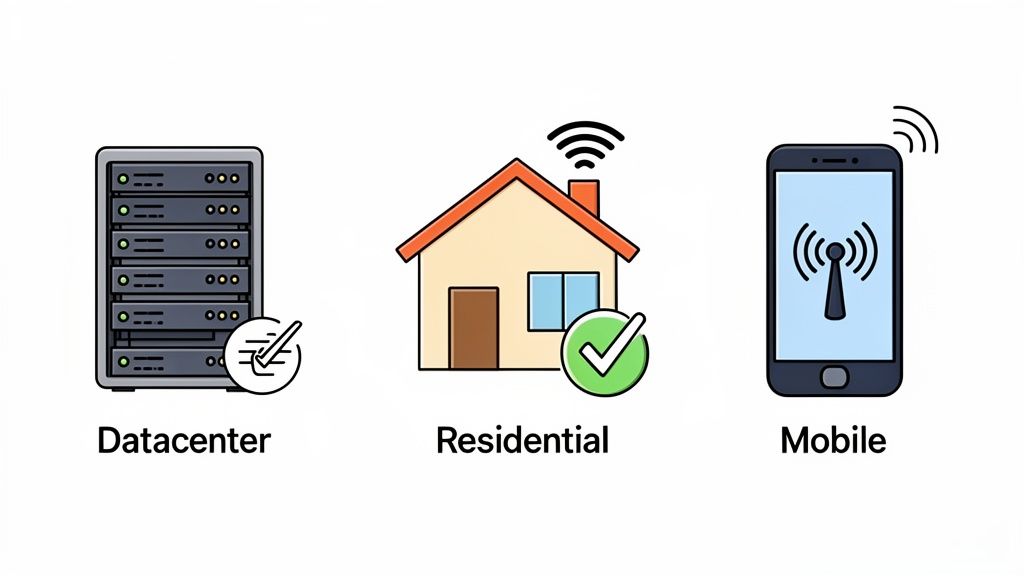
Datacenter Proxies: The Fast, Affordable Option
Datacenter proxies are the most common and budget-friendly option. These IPs don't come from an Internet Service Provider (ISP); they're generated in bulk by cloud providers and data centers.
Because they come from a commercial source, they're fast and cost-effective, which makes them a good fit for high-volume collection from sites with lighter rate limits.
That commercial origin is also their limitation. Bot detection systems often apply stricter limits to ranges of datacenter IPs, so they're less suitable for sites that serve large platforms like major e-commerce or social media. If you want to dig into how different proxy mechanisms work, guides on how to configure a reverse proxy offer useful background.
Residential Proxies: Real-User IPs
Residential proxies are a strong choice for most serious web scraping projects. These are real IP addresses assigned by ISPs to home internet connections, so requests originate from genuine residential addresses.
Because these IPs are tied to ordinary residential connections, sites generally apply normal per-IP limits to them rather than treating whole ranges restrictively. That makes them well suited to collecting data from e-commerce sites, social networks, and other high-traffic domains where you need consistent, reliable collection.
The numbers reflect this. Residential proxies account for 44% of total proxy usage, with millions of active IPs available worldwide. Teams often report a 56% improvement in successful data extraction when they use IP rotation to stay within rate limits.
Mobile Proxies: Carrier-Assigned IPs
Mobile proxies are IP addresses assigned to mobile devices by cellular carriers. They tend to receive the most lenient per-IP treatment from sites.
Why? Mobile IPs are dynamic by nature. A carrier may rotate the same IP across many users over a short period, so sites apply limits to mobile IPs carefully to avoid affecting legitimate customers. That makes them effective for collecting data from sites with strict limits.
The trade-off is cost. Mobile proxies are the most expensive option, so they're typically reserved for targets where other proxy types run into limits and the data is especially valuable.
Comparing Proxy Types for Web Scraping
To make the right call, it helps to see the options side by side. The table below offers a quick comparison.
| Proxy Type | Source | Trust Level | Cost | Best For |
|---|---|---|---|---|
| Datacenter | Cloud service providers | Low | Low | High-volume collection on sites with light rate limits. |
| Residential | Internet Service Providers (ISPs) | High | Medium | Collecting from e-commerce, social media, and high-traffic sites. |
| Mobile | Mobile carriers | Very High | High | Sites with the strictest rate limits and mission-critical tasks. |
For a more detailed breakdown of different providers and what they offer, you might find our comprehensive guide to the best proxy services for 2025 helpful.
Choosing the right proxy is a balance of your budget, the scale of your operation, and how strict your target's rate limits are.
Advanced Rotation Strategies
Swapping IPs is the baseline. To collect data reliably from sites with strict bot detection systems, you also want consistent request patterns across the other signals your scraper sends. It's not just whether you rotate, but how you rotate and what else accompanies each request.
The enterprise world has caught on. The rotating proxy market was valued at 1.25 billion in 2022 and is expected to reach 3.50 billion by 2030. That growth reflects broad demand for reliable data collection at scale.
Choosing Your Rotation Tactic
Not every scraping job is the same, so your rotation strategy shouldn't be either. The two main approaches serve different needs, and picking the right one matters.
-
Rotation Per Request: A new IP is assigned for every request you send, which spreads load most evenly. It's ideal for large-scale jobs collecting many separate data points, like pulling every product listing off a category page.
-
Sticky Sessions: Sometimes you need the same IP for a while—for example, navigating a multi-step checkout or a logged-in flow you're authorized to access. A sticky session keeps the same IP for a set time so those workflows complete without breaking mid-session.
Think of it this way: rotating per request spreads each item on a shopping list across different shoppers, while a sticky session sends one shopper through the whole store, cart and checkout included. Both work, but for different situations.
Beyond IPs: Consistent Request Signals
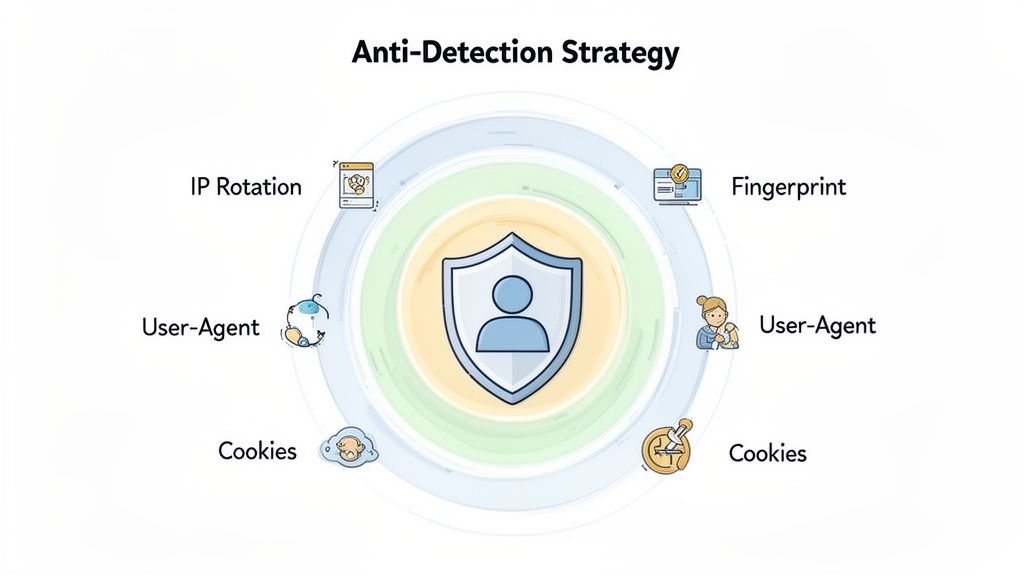
IP rotation distributes your request volume, but sites also look at the rest of each request to decide how to handle it. They consider your full set of request details—browser, system, and network signals. For requests to work reliably, those signals should be consistent and well-formed.
Managing Headers Consistently
Every request carries information in its headers describing the device and browser making it. Sending headers that are inconsistent or malformed leads to failed requests. The goal is to keep these values realistic and internally consistent.
-
User-Agents: This string identifies the browser and OS (like "Chrome on Windows 11"). Using real, current user-agents keeps requests well-formed.
-
Request Headers: Beyond the user-agent, headers like Accept-Language and Accept-Encoding round out the request. The key is keeping these values consistent and logical for each user-agent you send.
Cookie and Session Handling
Websites use cookies to track sessions. A scraper that ignores cookies or handles them clumsily produces inconsistent requests that are more likely to fail. Handling cookies properly means accepting, storing, and returning them the way a normal browser would, so multi-step flows behave correctly.
Platforms like Scrappey build these techniques into the service. When you make an API call, it doesn't just assign a new IP; it also sends a consistent set of browser headers and manages cookies for you. You can learn more in our documentation on Scrappey's session handling capabilities. Bundling these together produces clean, consistent requests that work reliably with the site's infrastructure.
Putting Rotating Proxies Into Your Scraper
Knowing the theory is one thing; putting it to work is where you see results. This is where you connect the strategy to your code, turning a fragile single-IP scraper into a resilient data-gathering tool. How you implement it makes a real difference.
You have two main paths: the do-it-yourself (DIY) route or a dedicated web scraping API. Each has big implications for your development time, maintenance load, and the overall reliability of your project.
The DIY Proxy Management Challenge
If you go the DIY route, you're effectively taking on proxy infrastructure work. You'll source proxy IP lists, write logic to cycle through them, and build systems to handle the failures that inevitably occur.
Your code has to juggle several tasks at once:
-
IP List Maintenance: You have to find and constantly refresh a list of working proxy IPs, which is tedious and often unreliable.
-
Rotation Logic: Your script needs to pick a fresh proxy for each request, avoid reusing failing IPs, and distribute load evenly so no single IP exceeds the site's rate limit.
-
Error Handling and Retries: When a proxy fails, your scraper has to catch the error, drop the bad IP, grab a new one, and retry—without crashing.
This path takes hundreds of lines of boilerplate just for infrastructure, pulling you away from your actual goal of collecting data. It's a steady stream of dead proxies, network errors, and hard-to-track bugs.
The Streamlined API Approach
Using a web scraping API like Scrappey removes that complexity. Instead of building a proxy management system from scratch, you make a single API call from your scraper.
The API approach changes the problem. Instead of "How do I build and maintain a complex proxy rotator?" you simply ask, "What data do I need?" The API handles the rest.
Say you're collecting product data from a major e-commerce site. A single API call to Scrappey replaces the manual proxy logic. The platform handles IP rotation, renders JavaScript-heavy pages, and manages the request signals that would otherwise cause a DIY scraper to fail.
For developers and data engineers, this means reliable use of a large pool of rotating residential proxies—over 5.5 million in active use globally. Distributing requests this way can improve scraping success rates by 56% by keeping requests well-formed and within rate limits. As automation grows, rotating proxies are increasingly important for handling dynamic content, reducing engineering overhead, and building scalable data pipelines. You can find more on these market trends on archivemarketresearch.com.
By offloading the infrastructure burden, your team can focus on delivering data insights, and faster. To see how simple it is to get started, check out our guide on creating scraper sessions with Scrappey.
Best Practices for Ethical and Effective Scraping
Rotating proxies open up a lot of public data, and that comes with responsibility. Scraping thoughtfully isn't just about avoiding problems; it keeps your data sources healthy over the long run and protects your project from legal and reputational risk.
The golden rule is to scrape politely. A website's server has finite capacity. If you blast it with hundreds of requests a second, you can degrade it for everyone. Keep your request pace consistent and moderate. Adding random delays between requests is a simple, effective way to avoid overloading the server.
Be Transparent and Respectful
Beyond pacing, transparency helps. Identify your scraper with a clear, descriptive User-Agent in your request headers, like MyCoolScraper/1.0 (+http://mycompany.com/bot-info). It gives site admins a way to reach you if your bot is unintentionally causing load.
Another essential step is to respect the robots.txt file. This is a simple text file where sites publish rules for automated visitors.
Think of robots.txt as the site's stated rules for automated access. Ignoring it is bad practice and a fast way to have your requests refused.
Make it a habit to check this file before scraping any new domain, and honor any Disallow directives you find.
Stay Legally Compliant
Finally, make sure your data gathering is legally sound. Stick to publicly available information you're authorized to access, and steer clear of anything behind a login you don't have permission for or content loaded with personal data.
Be aware of the major legal frameworks that protect personal data:
-
General Data Protection Regulation (GDPR): If you're handling data about anyone in the EU, you must follow its rules on personal data.
-
California Consumer Privacy Act (CCPA): California's framework, giving its residents significant rights over their personal information.
When you pair tools like rotating proxies with a respectful, compliant approach, you're not just collecting data—you're building sustainable, responsible projects that last.
Common Questions About Rotating Proxies
Even with a solid plan, you'll run into specific questions when you start using rotating proxies for web scraping. This section tackles the most common ones with quick, practical answers.
Think of it as a reference for the "what-if" moments that can stall a project, so you can get unstuck and keep moving.
Can I Use Free Proxies for Rotation?
While "free" is tempting, free proxies are a poor choice for any serious project. They're unreliable, slow, and frequently already rate-limited or refused by major sites.
More importantly, they're a security risk. Your data could be monitored, altered, or stolen by whoever runs the service. For consistent, scalable, and secure scraping, a reputable provider is the only way to get reliable results.
How Do I Handle CAPTCHAs When Using Proxies?
CAPTCHAs appear when a site's bot detection system wants to confirm a human is present—often when request volume from an address is high or requests look inconsistent. High-quality rotating proxies that keep requests well-formed and within rate limits tend to reduce how often they show up, but they can still appear.
When they do, the right response is to design automation that respects them rather than working around them:
-
Slow Down: Reduce your request rate and add delays. CAPTCHAs frequently signal that you're pushing a site's limits, so easing off helps.
-
Reduce Concurrency: Lower how many requests you run in parallel so you're not concentrating load on a single address, and pause that workflow rather than hammering the challenge.
-
Route to Human Review: Treat a CAPTCHA as a stop signal—hand the workflow off for human review instead of trying to clear it automatically.
-
Request Access: If you need the data regularly, check whether the site offers an official API or a data-access agreement. That's the most reliable, authorized path.
If CAPTCHAs are appearing often, treat it as feedback that your automation is too aggressive or the data needs an authorized channel—not as an obstacle to push through.
What Is the Difference Between Random and Sequential Rotation?
Sequential rotation cycles through your IP list in a fixed order (1, 2, 3, and so on). That predictability can cause requests to cluster on certain addresses and is easy for bot detection systems to anticipate.
Random rotation pulls the next IP from your pool at random, which spreads load more evenly across the whole pool and avoids predictable patterns. For this reason, modern proxy services use random rotation algorithms for more consistent, higher success rates.
Ready to spend less time managing infrastructure and more time on data? With Scrappey, you get access to a large pool of premium rotating proxies, consistent request handling, and reliable retries through a simple API call. Start collecting the data you're authorized to access with Scrappey today.