
Discover what are residential proxies and how they power scrapers
A residential proxy routes your internet traffic through an IP address that an Internet Service Provider (ISP) assigned to a real home connection. Because those addresses come from real ISP networks rather than commercial data centers, requests routed through them tend to be more reliable and geographically accurate for collecting public data you're authorized to access.
A quick note on authorized use: this guide assumes you are collecting public data you have permission to access, in line with each site's terms and applicable law.
Understanding Residential Proxies and Their Value
Here's a simple way to picture it: you need to check local store prices in another city. A residential proxy lets your request travel through a real, ISP-provided connection in that location, so the store's site sees a request that originates from a normal home internet address in the region you're targeting.
That ISP origin is the key feature. Traffic from real home connections is consistent and well-formed, which tends to mean fewer failed requests and more accurate location-based results. It's this combination of reliability and geo-accuracy that makes residential proxies useful for a range of data collection tasks.
Core Characteristics of a Residential Proxy
So, why is the ISP-backed connection so useful? It comes down to a few key features that set residential proxies apart from datacenter alternatives. Understanding these makes it clear why they're a good fit for reliable, location-aware data collection.
-
ISP-Assigned IP Addresses: They use real IP addresses provided by ISPs, so requests come from ordinary home internet ranges rather than commercial subnets.
-
Geographic Accuracy: Because the IPs map to real locations, results reflect what a user in that region would actually see.
-
Geo-Targeting: You can route requests through specific countries, states, or even cities, which is ideal for viewing localized content or verifying regional ads.
The market for these proxies is growing steadily, with a projected growth rate of approximately 11.48% annually. This is driven by demand for accurate, location-specific data to support data-driven business decisions. You can read the full research about this market growth to get a better sense of the trend.
A residential proxy's main advantage is its origin. Because the IP address is tied to a real ISP and physical location, it behaves more like ordinary home traffic than an IP from a commercial data center, which improves consistency for authorized collection.
To help you quickly grasp the main points, here’s a simple table summarizing what makes a residential proxy tick.
Residential Proxy Key Characteristics at a Glance
| Characteristic | Description |
|---|---|
| IP Source | Real IP addresses assigned by Internet Service Providers (ISPs). |
| Origin | Ordinary home internet ranges rather than commercial subnets. |
| Reliability | High; consistent, well-formed requests reduce failed connections. |
| Geo-Targeting | Precise targeting by country, state, and city. |
| Primary Use | Web scraping, ad verification, and market research. |
| Cost | Generally higher than datacenter proxies. |
This table provides a quick snapshot, but remember that the real value comes from applying these features to your specific needs.
For anyone serious about web scraping, ad verification, or market research, knowing the difference between proxy types is non-negotiable. Our comprehensive guide to the best proxy services for 2025 is a great place to start comparing your options.
How a Residential Proxy Network Actually Works
Knowing what residential proxies are is one thing; understanding how they operate at scale is where their value becomes clear. At its heart, a residential proxy network is a large, well-organized system for routing your internet traffic through real ISP-assigned home connections.
Think of it as a global mail-forwarding service for your data. When you make a request, it doesn't travel straight from your computer to the target website. Instead, it hits the proxy provider's network first. From there, the network picks an available residential IP from its large pool—an ISP-assigned address somewhere in the world—and sends your request from that location.
This flowchart breaks down the journey your data takes from your machine, through the proxy, to its final destination.
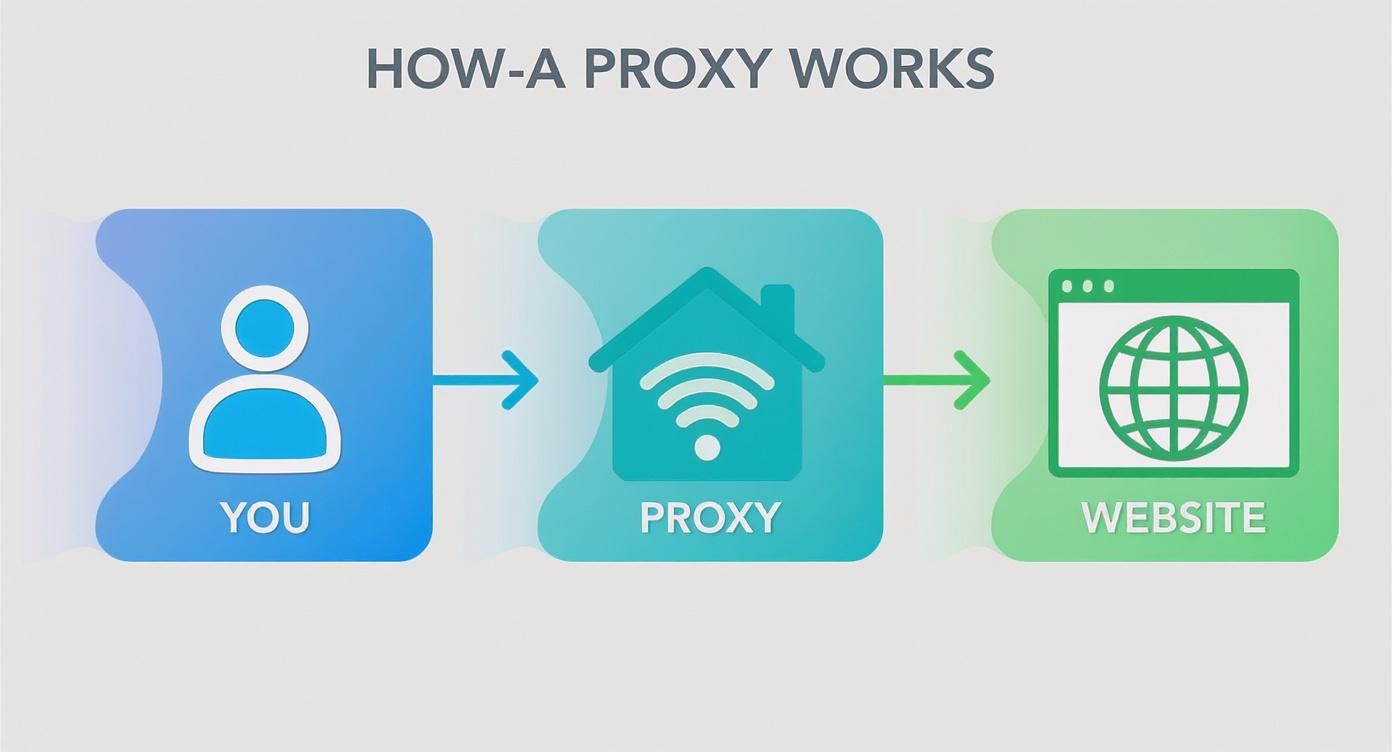
As you can see, the proxy server sits between you and the target. It routes your request through a real residential IP before it reaches the destination, so the request originates from an ordinary ISP-assigned address in your chosen region.
Understanding IP Rotation and Sessions
A core feature that makes these networks useful at scale is IP rotation. Instead of sending every request from the same IP, the network can automatically assign a fresh one. Distributing requests across many addresses helps you stay within per-IP rate limits, which reduces HTTP 429 responses and failed requests during large jobs.
Providers usually give you two ways to control this rotation, which they call sessions:
-
Rotating Sessions: This setting gives you a new IP address for every connection request. It's well suited to tasks that need many quick, independent data points, like collecting public product prices across an e-commerce catalog, since spreading requests across addresses keeps you under per-IP limits.
-
Sticky Sessions: This approach keeps the same residential IP for a set amount of time, typically a few minutes up to half an hour. It's important for any task that needs a consistent session, like an authorized account workflow or working through a multi-step checkout process.
By controlling how and when your IPs rotate, you can maintain a consistent connection profile that fits the task. A rotating session distributes requests across many sources, while a sticky session keeps a single, stable identity for a multi-step flow like filling up a shopping cart.
Choosing the right session type comes down to what you're trying to do. If you're collecting large volumes of public data, frequent rotation keeps you within per-IP rate limits. But for anything that requires a stable login or multi-step session, a sticky IP keeps the session consistent from start to finish. This flexibility is what makes residential proxies a practical tool for developers and data analysts.
Residential vs Datacenter vs Mobile Proxies
Getting a handle on what residential proxies are is much easier when you see how they stack up against the other options. Not all proxies are built for the same job, and picking the right one boils down to what your project actually needs.
Think of it like choosing a vehicle for a specific trip. Each type has its own strengths and weaknesses that make it perfect for one task but a terrible fit for another.

This simple comparison gets right to the heart of the trade-offs between speed, cost, and reliability that define the proxy world.
Datacenter Proxies The Fast Sedan
Datacenter proxies are the affordable sedans of the proxy world. They're created artificially in cloud data centers, which makes them incredibly fast and cheap to buy in bulk. Just like a sedan cruising down a smooth, open highway, they're a great fit for high-speed tasks where the road is predictable and the source of the request doesn't matter.
The catch? Their origin is also their main limitation. Because their IP addresses come from the same commercial subnets, sites that distinguish datacenter ranges may apply tighter rate limits to them. They're a good fit when you need raw speed and cost is your main concern, but they don't offer the same consistency as the other options.
For a deeper dive, Scrappey has a detailed guide to datacenter proxy usage. And if you want to understand the bigger picture behind their infrastructure, exploring topics like data center management can be eye-opening.
Residential Proxies The All-Terrain SUV
This is where residential proxies come in—they're the versatile, all-terrain SUVs of the group. These proxies use real IP addresses assigned by Internet Service Providers (ISPs) to home connections. Because the traffic originates from ordinary ISP ranges, it tends to be handled consistently and runs into fewer per-IP rate limits.
Their reliability does come with a higher price tag. But for tasks like web scraping, ad verification, or other authorized automation, they're often the right choice. They tend to work reliably even with strict bot detection systems, much like an SUV handles rugged terrain without trouble.
The core value of a residential proxy is its ISP origin. Because requests come from real home internet ranges, they behave consistently and reliably for collecting public data you're authorized to access.
Mobile Proxies The Armored Truck
Finally, we have mobile proxies. Think of these as the armored trucks of the proxy world. They route your traffic through IP addresses assigned to mobile devices on cellular networks like 4G or 5G. Sites tend to apply looser rate limits to mobile IPs, since many real users share carrier-grade NAT addresses.
That makes them the most expensive and often the slowest option. But when a task demands carrier-network conditions—like testing mobile apps or verifying carrier-specific content—their reliability is hard to beat.
Proxy Type Comparison Residential vs Datacenter vs Mobile
To make it even clearer, let's break down the key differences in a simple table. This will help you see the pros and cons of each proxy type at a glance.
| Feature | Residential Proxies | Datacenter Proxies | Mobile Proxies |
|---|---|---|---|
| IP Source | Real home Wi-Fi (ISP) | Cloud data centers | Cellular networks (4G/5G) |
| Cost | High | Low | Very High |
| Speed | Moderate | Very Fast | Slow to Moderate |
| Rate-Limit Headroom | High | Low | Very High |
| Best Use Cases | Web scraping, Ad verification | High-speed, bulk tasks | Mobile-specific testing |
As you can see, there's no single "best" proxy—it all depends on balancing your need for speed, budget, and geo-accuracy. Choosing the right one is about matching the tool to the specific job you have in mind.
Where Residential Proxies Make a Real Difference
Okay, so we've covered the nuts and bolts of how residential proxies work. But where do they really help? Seeing them in action makes the value concrete. They're a practical tool for businesses that need clean, location-accurate web data to stay competitive.
Their strength is that requests originate from real ISP ranges in the region you choose, which keeps results consistent and accurate. That makes them useful for everything from monitoring public competitor prices to confirming your website works correctly for customers on the other side of the world.
Unlocking Large-Scale Web Scraping
For anyone in e-commerce or market research, large-scale web scraping is a daily task. Pulling pricing data from thousands of product pages by hand isn't realistic. Scripts can do the job in minutes, but sending a flood of requests from a single datacenter IP quickly runs into per-IP rate limits and HTTP 429 responses.
This is where residential proxies help. By rotating across a large pool of real home IP addresses, your scraper distributes requests so no single address exceeds the site's per-IP limits, which means more successful responses when collecting pricing, stock levels, and product details you're authorized to access. That same distribution is what helps resolve rate limit exceeded errors and other common scraping headaches.
Over 650 million proxy requests are processed every day, and residential proxies account for 44% of that traffic. The biggest users are in e-commerce and fintech, where getting precise, location-accurate data reliably is what matters most.
Powering Global Marketing and SEO Insights
Residential proxies are also valuable for modern digital marketing and SEO. They solve some of the trickiest problems related to location-based targeting and campaign monitoring.
Here are a few ways they make a huge impact:
-
Ad Verification: Marketers need to know their ads are running correctly. They use residential proxies to check campaigns from different cities and countries, confirming ads show up to the right audience and spotting any fraudulent ad placements that could harm their brand.
-
Localized Content Testing: If you’re a global brand, you have to nail the local user experience. A developer in the US can use a residential IP from Japan to see exactly how the Japanese version of their website loads, looks, and feels for a visitor in Tokyo. No guesswork needed.
-
SEO Rank Tracking: Search engine results change dramatically based on where you are. An SEO specialist uses proxies to check keyword rankings from dozens of different cities, getting a true picture of how they perform across various markets instead of just seeing their own biased, local results.
Choosing the Right Residential Proxy Provider
With so many residential proxy providers available, picking the right one can be tricky. The right partner gives you a steady stream of reliable, clean IPs. The wrong one leaves you with frequent failed requests and a depleted budget. The trick is to focus on a few key criteria to cut through the noise.
The market has exploded recently, largely thanks to the growing demands of AI and large-scale data collection. There are now over 250 providers out there, and the intense competition has driven prices down by as much as 70% in just a couple of years. This has made powerful proxy tools more accessible than ever before.
Evaluate the IP Pool and Geo-Targeting
First things first: look at the provider's IP pool. Size and diversity matter a lot. A large, varied pool means you're far less likely to get stuck with an overused IP that's already hitting rate limits. Ask them directly about their network size and how many unique IPs they have in the locations that actually matter to you.
Just as important is how precise their geo-targeting is. Can you zero in on a specific country, state, or even city? For tasks like tracking local SEO performance or verifying regional ad campaigns, this kind of granular control isn't just a nice-to-have; it's a must. Make sure they can deliver the exact locations your project depends on.
Review Rotation Settings and Integration Options
Next up, check out how flexible their IP rotation is. A solid provider will give you options for both rotating sessions, where you get a new IP for every single request, and sticky sessions, which let you keep the same IP for a set amount of time. This control is critical for maintaining a consistent connection profile, whether you're doing quick data lookups or filling out a multi-step checkout form.
You also need to think about how easily their service will plug into your existing workflow. A robust API that lets you automate proxy management is a huge plus. Platforms like Scrappey are designed to handle this complexity for you, so you can focus on getting the data you need. For a real-world example, see how easy it is to use Scrappey's premium proxy features and what seamless integration looks like.
A provider's value isn't just in the IPs they offer, but in the control and automation they provide. A powerful API and flexible session management are signs of a mature and reliable service.
Finally, always prioritize providers who are transparent about their IP sourcing and pricing. You want to be sure they get their IPs with full, informed consent from the device owners. And of course, look for clear, upfront pricing with no hidden fees. This helps you budget accurately and avoid nasty surprises down the road.
Common Questions About Residential Proxies
Even after getting the hang of what residential proxies are, a few questions tend to pop up again and again. Let's tackle them head-on. Clearing these up will help you understand the practical and ethical side of things, so you can move forward with confidence.
Are Residential Proxies Legal to Use?
Yes, using residential proxies is perfectly legal for legitimate activities. The real question isn't about the tool itself, but how you use it and, just as importantly, how the provider gets their IPs. Things like market research, ad verification, and price comparison are all completely above board.
Where you run into trouble is using any proxy for illegal stuff—think hacking, spamming, or creating fake accounts. That’s a definite no-go. It's also critical that you pick providers who source their IP addresses ethically, with full, informed consent from the device owners.
Why Are Residential Proxies More Expensive?
The higher price tag on residential proxies comes down to the sheer complexity and cost of building and maintaining their network. It's a completely different ballgame from datacenter IPs, which are churned out in bulk from a server farm. Residential IPs come from real home internet connections, managed by real ISPs.
This process involves paying the people who consent to share their devices on the network and managing a large, geographically distributed system. That premium price reflects the reliability of genuine ISP-backed connections—a meaningful advantage for serious, authorized data collection.
How Do Residential Proxies Affect Reliability?
Because residential traffic comes from real ISP-assigned IP ranges, requests tend to be handled consistently, which can mean fewer failed requests when collecting public data you're authorized to access.
Sites commonly apply tighter rate limits to IP ranges they associate with data centers, or throttle a single IP that sends an unusually high request volume (often returning HTTP 429). Residential proxies help here by spreading requests across many real, rotatable IPs, so each address stays within the site's per-IP limits. The goal is well-formed, consistent requests at a sustainable pace—not avoiding any site's protections.
Ready to collect the web data you're authorized to access, more reliably? Scrappey provides ethically sourced residential proxies integrated into a managed web scraping API that handles rotation, sessions, and request complexity for you. Start collecting the data you're authorized to access with Scrappey today!